
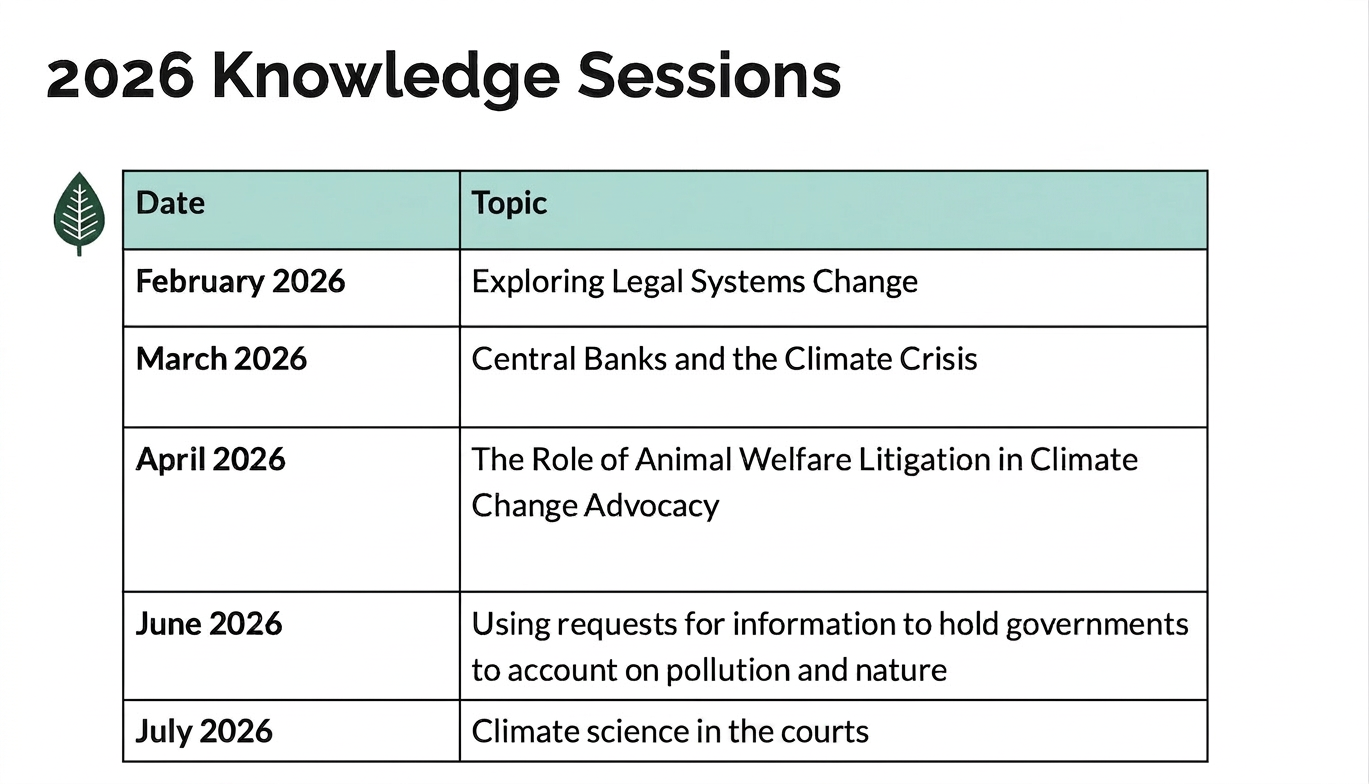
Missed any of our knowledge sessions? Or perhaps you joined us and want to watch them all over again? Check out overviews and recordings of our past events from 2026 below.
Session recordings are also accessible directly via our YouTube channel.
2 July 2026: Climate Science in the Courtroom
Presentation: This session drew on three guides designed to help legal professionals, policymakers, researchers and scientists navigate the rapidly evolving field of climate litigation, focusing on the evidentiary basis of “polluter pays” cases.
Author Joy Reyes kicked off the session with a high-level summary of findings from the LSE’s Grantham Research Institute on Climate Change & the Environment‘s Global trends in climate change litigation: 2026 snapshot report, and an overview of the Institute’s research on climate litigation from the evidentiary point of view – including examining what kind of evidence is used, at what point in the case, and how courts engage with it.
Author Nicholas Petkov discussed the guide “Science in the courtroom: evidentiary needs in climate litigation“, which sheds light on how different types of cases, and case strategies, require different types of evidence, and what has made science relevant and compelling for litigation.
Author Emily Theokritoff then addressed the topic of the third guide – Constructing the causal chain: attribution science in polluter pays climate litigation, looking at hazard, impact and source attribution, and related legal and normative considerations.
Group discussion: In a break with the “traditional” knowledge session format, attendees applied their understanding to discuss the arguments and issues explored in the guides in roundtable style.
The slides from the presentation can be found here.
4 June 2026: Using requests for information to hold governments to account on pollution and nature
Led by Nia Simeonova, Dow Jones, OPIS
Presentation: In this session, we explored the freedom of information regime and the legislation governing access to environmental information, including the Freedom of Information Act and the Environmental Information Regulations. Nia guided our understanding of how journalists use these legal frameworks to conduct public interest investigations, and highlighted the vital role that lawyers play in supporting this work.
Panel interview: The session also featured a discussion with a diverse panel of leading legal professionals and journalists: Alex Shattock of Landmark Chambers, Ruth Chambers of Green Alliance, and Yusuf Khan of The Wall Street Journal.
Creative content: In this session, we read the short philosophical story “The Ones Who Walk Away From Omelas”. This powerful thought experiment touched on some of the topics covered by the session, including the concept of knowledge hiding in plain sight and what to do with it.
15 April 2026: Overlooked: The Role of Animal Welfare Litigation in Climate Change Advocacy
Led by LVF member Charlotte Edgar.
Presentation: In this session, Charlotte’s presentation explored the intersection of animal law and climate litigation and why climate lawyers should advocate for improved animal welfare, both as a goal in itself and as part of more complete and effective strategies to address climate change. The session provided an introduction to the climate impacts of industrial animal agriculture, explored recent and future trends in animal welfare and climate litigation, and compared and contrasted animal law in several jurisdictions.
Panel interview: The session also featured a panel discussion with guest speakers David Wolfe KC (a barrister at Matrix Chambers, specialising in public law), Edie Bowles (a solicitor and founder of Advocates for Animals), and Steph David (a barrister at 39 Essex Chambers).
Creative content: In this session, we considered an engaging excerpt from a thousand year old fable “The Animals’ Lawsuit Against Humanity”, by Anson Laytner and Dan Bridge. This fable, adapted for modern times, encourages us to critically examine our relationship with animals and the natural world.
The slides from the presentation can be found here.
16 March 2026: Central Banks and the Climate Crisis
Led by LVF Stewardship Committee Member Martina Menegat
Presentation: Martina explained how central banks have been integrating climate risks in their mandates and core functions, including monetary policy, financial stability, and supervision of financial institutions.
Panel interview: The session featured a panel discussion with guest experts Megan Bowman, Professor of Law and Director of Centre for Climate Law & Governance at King’s College London, Dan Eziefula, Lawyer at ClientEarth’s Accountable Finance Team and Daniel Segoin, Senior Legal Counsel at the European Central Bank.
Creative content: The session concluded with a collective reading of The Train Has Whistled by Luigi Pirandello, prompting reflection on how creativity and collaboration – both internal and external – can foster innovation even within traditionally conservative legal and institutional frameworks.
Recording:
18 February 2026: Exploring Legal Systems Change
Led by LVF Stewardship Committee Member Vicky Vanderstichele
Presentation: Vicky led a session that explored what it could to change the legal structures that underpin our current economic, social, and political system. The session was highly interactive and encouraged all participants to rethink the poly-crises facing us today, taking the form of a workshop and group discussion.
A recording for the first half of this session will be made available soon.

