
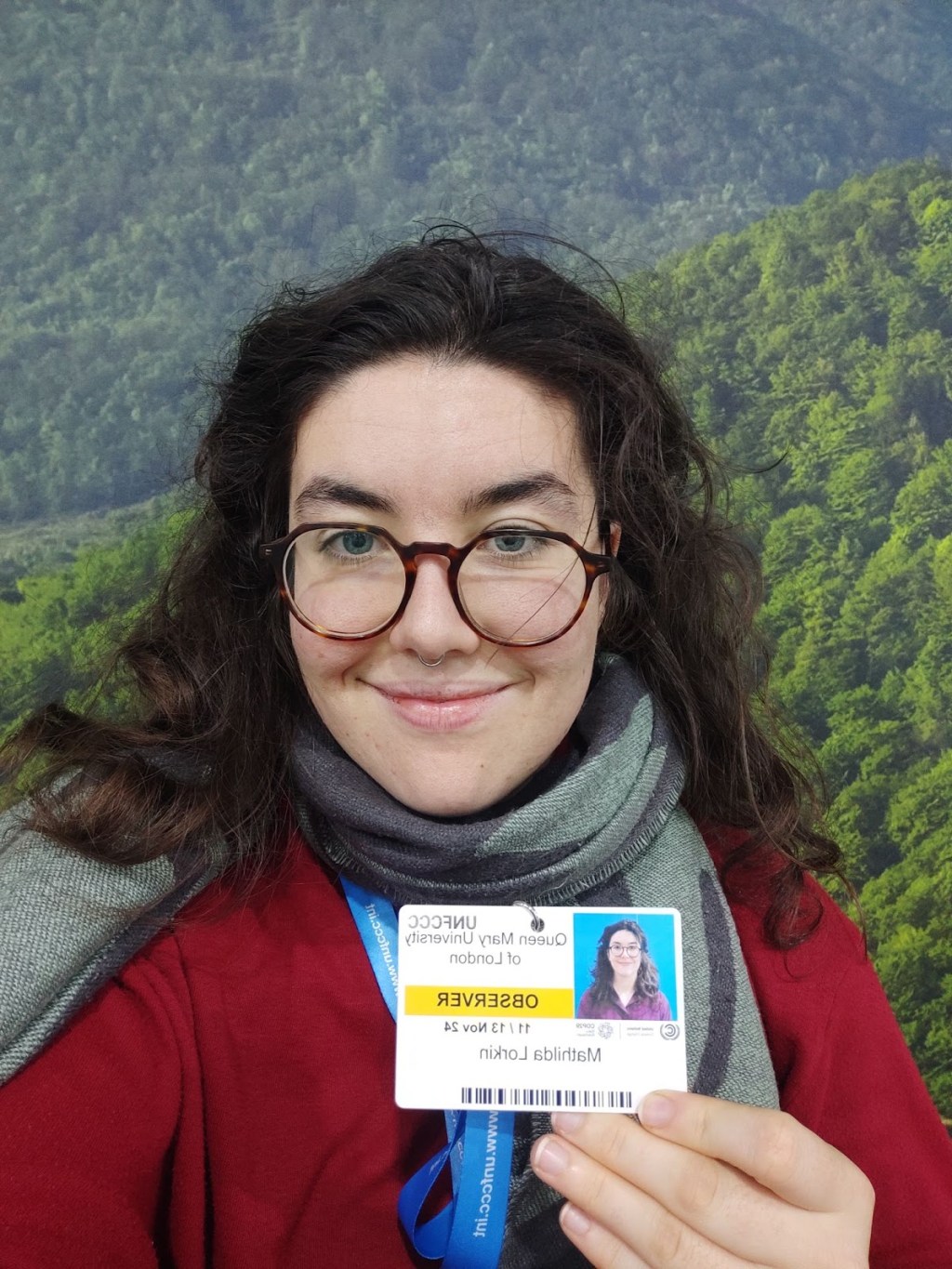
Now that we’re in the run-up COP30 in Brazil in November, we interviewed our member Mathilda Lorkin about her experience at COP29 in Baku last year – have a read of her key takeaways below!
1. Please could you tell us about yourself and your role on the ground at COP29?
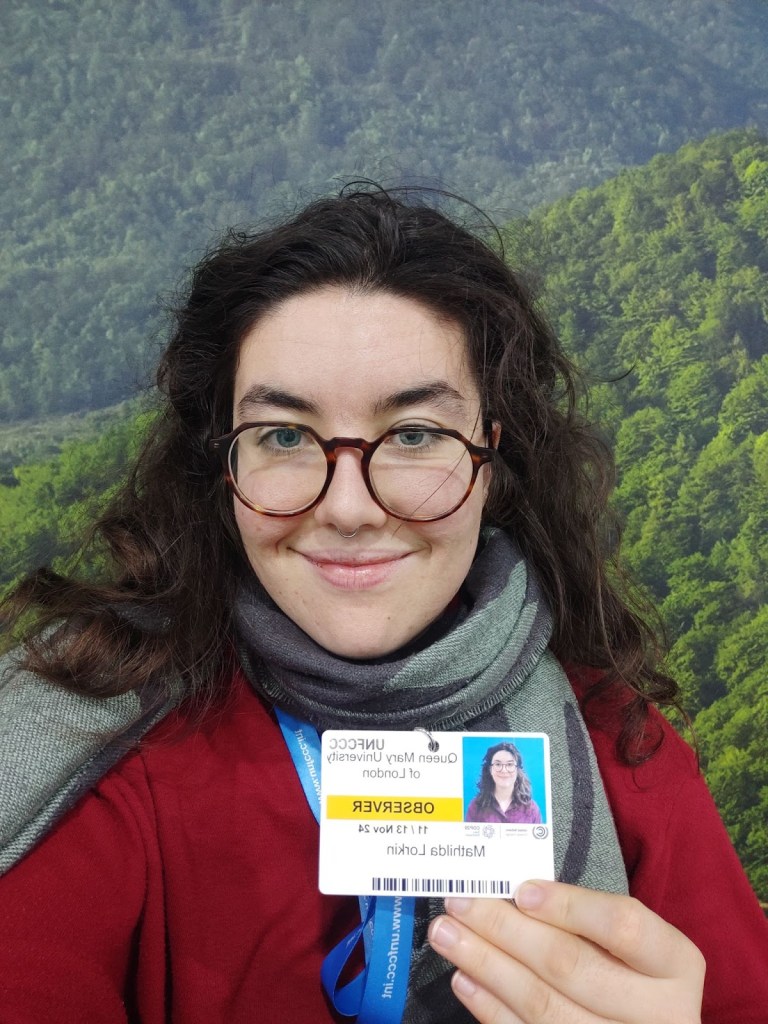
Sure – my name is Mathilda Lorkin, I am currently undertaking a PhD at Queen Mary University of London. My research focuses on the land-grabbing of indigenous territories in international law. It is as a PhD researcher that I attended COP29, so my role there was to attend negotiations pertaining to carbon markets, meet indigenous representatives, NGOs and members of the civil service to discuss land-grabbing. It was also an opportunity to share insights with relevant organisations.
2. How did you come to be attending COP29?
I have previously undertaken some NGO work on carbon markets as a driver for land-grabs, the role of indigenous peoples in climate negotiations and conflicts of interests within COPs. Thus, Queen Mary selected me to be part of their academic delegation!
3. How important is youth involvement at COPs, and is there space for young people to be involved?
There are many aspects to that question. Young people are quite heavily involved, as they are represented through a Youth Constituency and are generally part of separate NGOs. A constituency is an interest group which is officially recognised by the States which are party to the Climate conventions (United Nations Framework Convention on Climate Change and the Paris Agreement). This allows constituency members to be more closely involved in the COP process than the other civil society organisations.
Every year, the week before COP hosts the Conference of Youth (CoY) which is the result of a pyramidal network of local and regional CoYs. This allows for world-wide involvement of young people in climate issues, as the outcome of the CoY is usually presented to the parties during the COP opening plenary session. COP29 was a big disappointment on this front, as the role of CoY has been diminished. However, young people remain involved through other civil society bodies.
4. How did you prepare for it? Were there any resources you found particularly helpful to get up to speed and to follow the negotiations?
I prepared for COP29 by being in contact with actors involved in its preparation – French Youth NGOs are very active in that domain and I go to the French LCoY every year, mostly as a panellist now. COPs are very technical processes, at least when taken from a legal perspective, so having done my dissertation on carbon markets was very helpful. I also made good use of the plethora of online training offered by different bodies, especially the UN. It also helped to read policy briefs, the official positions of different State coalitions and catch up on what happened during the COP29 pre-negotiations. The IIED’s content and Climate Action Network’s ‘Eco’ online newspaper were of great help – they give a digestible yet complete overview of COPs. The Gomaluku podcast was also very helpful and especially interesting, as the host Ghazali Ohorella has been advocating for indigenous peoples’ rights in international processes for a while.
5. What is the most meaningful outcome you feel has been achieved at COP29?
I can share what a meaningful outcome would have been, but in this case I am not quite sure that much has been achieved. A meaningful outcome could have been to stop relying on market-based solutions completely, or at least to create extremely stringent social and environmental criteria for their operation. It could have been to address openly the prominence of the fossil fuel industry within COPs and take measures to deal with conflicts of interest – there can be no meaningful socio-ecological outcome to a process which allows part of the problem to come up with solutions.
However, COP30 might be a bit better, although COPs by themselves cannot induce the systemic change needed. It is only a relatively influential lever for change among a larger network of actors and institutions. In my opinion, we do need political fora to discuss potential futures which are socio-ecologically viable – and take steps to materialise desirable futures. Given the prominence of harmful economic discourses promoted by a range of public and private actors, COPs do not have the capacity to be these places just yet. However, they could be, with a little reorganisation of their functioning.
6. Were there any areas where the outcomes fell short of what you were expecting?
Yes, a lot of them – this COP was not much of a success. The question is all about the level of expectations that one has as to what multilateral meetings can achieve. This is especially true in a context of polarisation and strong corporate interests taking undemocratic paths to influence public policy makers – although given the tense political contexts, the influence often comes from within. The COP decision on carbon markets was a blow. The past few years have highlighted numerous structural issues with their use, affecting a variety of local communities around the world. Thus, it is necessary to be cautious as to the conditions of their implementation. Yet, the safeguards put forward in the COP decision are insufficient to prevent their misuse. It opens the door to heightened risks for the human rights of local communities who will be affected by these projects, with little space for prevention and accountability. This will also affect the environmental integrity of corporate commitments regarding greenhouse gas emissions reductions – in other words, it sheds light on the fact that these reductions are not happening.

7. Are there any particular moments that stood out for you?
I was particularly saddened by an event on climate-based forest protection schemes in Brazil. It was supposed to be a high-level event with the governors of different Brazilian States and indigenous representatives. The first panel was dedicated to the governors and the second to indigenous representatives. As soon as the governors finished, they all walked out – I found that very telling.
8. Was there anything that surprised you?
I was surprised to see such strong collaborations between UN official bodies and NGOs.
9. What measures did you see at COP29 to encourage inclusion of different groups of people in international discussions?
In terms of inclusion, COP29 was pretty poor as the host state did not make efforts to accommodate specific groups. COP in itself has a limited budget and staff, so inclusion measures are the responsibility of the host State. However, interest groups were still present at COP and doing their advocacy work, with a strong push to be more accessible to disabled people. Hopefully, COP30 in Brazil will be better and more local for some of the indigenous groups attending.
10. How do you view the role of COP Side Events, and did you feel that these were adequate?
Side Events allow civil society to organise discussions on topics of their choice, if approved by the COP’s administrative services. They are important, because they allow civil society to give some context to the ongoing COP negotiations, share insights and link all this to practical issues. They also allow the reframing of climate issues, which demonstrates that the way in which COPs deal with climate is limited – there are a lot of other possible approaches. At COP, most Side Events I attended provided a good mix of people from different backgrounds. However, their format did not always allow for meaningful exchanges in between panellists and with the public. The time constraints meant that issues were brushed upon quite superficially. Also, there were so many Side Events happening at the same time that it was hard to follow.
11. Has attending COP29 influenced your impressions of how successful multilateralism can be in addressing the climate crisis?
Attending COP29 did make me realise that we have to adjust our expectations to the realities of multilateralism. We cannot ask COPs in their actual structure to address the climate crisis, at least not efficiently. From my perspective the environmental problems are not even always framed in adequate terms – for starters, it should start by drawing consequences of the fact that what we call the climate crisis is human induced. Lobbyists have a lot of power, inside and outside of these spaces – they influence the narratives around climate change and make it seem as disconnected as possible from industrial interests. It is very worrying, especially in a time where fascism is on the rise and when there are strong attempts to weaken scientific facts. Time is of the essence and this is not compatible with the actual rhythm of multilateral meetings, especially not within the actual geopolitical context. So, COPs are necessary in their existence but should not be overestimated in what they can actually achieve – at least not in today’s context.
12. After attending COP29, what gives you hope for the future?
What gives me hope in the future is the tremendous work done by civil society organisations. It is amazing to see how well organised and informed they are at international level. How successful some of their advocacy work is and how they are willing to train others to reproduce these successes. How committed some people are to try and make it work for them and others. I also think that when hope is wearing thin, collective action remains essential – it offers solidarity and most importantly hope.
To learn more about COP29, have a look here, and to learn more about the Paris Agreement see here. Find out more about indigenous rights and the destruction of rainforests here, here and here.
Please note the views expressed here are of the interviewee, not Legal Voices for the Future.
 Legal Voices for the Future
Leave a comment