
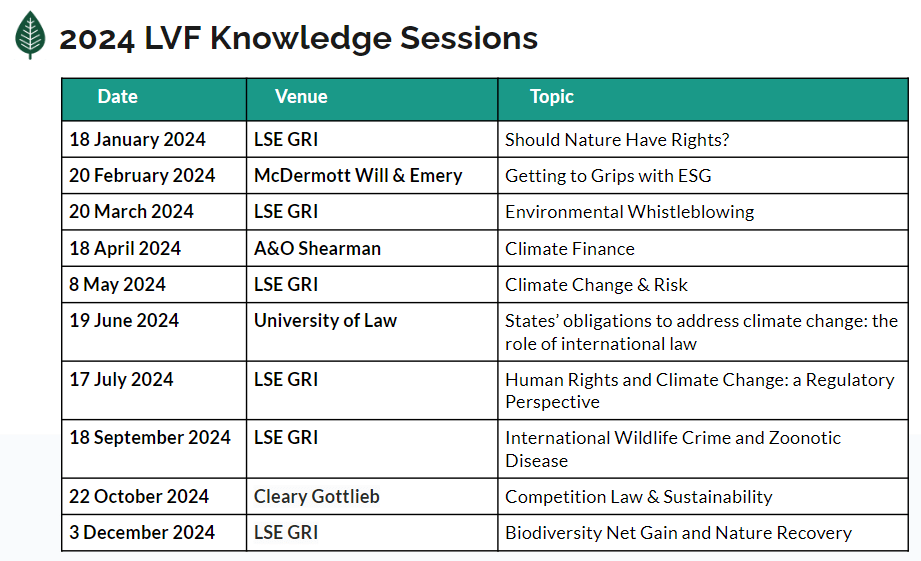
Missed any of our knowledge sessions? Or perhaps you joined us and want to watch them all over again? Check out overviews and recordings of our past events from 2024 below.
Session recordings are also accessible directly via our YouTube channel.
18 January 2024: Should Nature Have Rights?
Led by Flora Curtis, LVF Stewardship Committee Member and barrister at FTB Chambers.
Presentation: Flora discussed the rights of nature movement, part of the wider earth law movement that seeks to put ecocentrism at the heart of environmental law. Flora explored how modern environmental law has failed to make progress in preventing environmental degradation, and posed the question whether or not a radical shift in the way we relate to the environment is needed in order to prevent further deterioration. How have rights of nature been recognised by courts and states across the globe, and how might the rights of nature movement fit into the UK context?
Panel Interview: The session included a panel interview with the following guest practitioners and academics who will bring the topic of the presentation to life by discussing their own involvement in the domestic and international rights of nature movements:
- Paul Powlesland is a barrister and the co-founder of Lawyers for Nature. He regularly gives talks and workshops on the rights of nature, the relationship between the law and the natural world and what barristers and other lawyers should do in a time of climate and ecological emergency.
- Emma Montlake is the joint Executive Director of the Environmental Law Foundation and Head of Casework. Emma is a solicitor; passionate about nature and wildlife. Emma is a Director of Love Our Ouse, a CIC looking to play a pivotal role in the progress of the Rights of the River Ouse.
- Professor Jérémie Gilbert is a human rights scholar and activist who has extensively worked and published on the interaction between human rights law, ecological justice and the rights of nature.Jérémie regularly serves as a consultant for the United Nations, and as a legal expert, he has been involved in providing legal briefs, expert opinions, witness statements in several cases of litigation. He has recently led the establishment of the Interdisciplinary Network on the Rights of Nature
Creative content: This was an imagination exercise led by Phoebe Tickell, the founder and CEO of Moral Imaginations.
Phoebe has a radical proposition: that all the problems of the world are solvable today. The issue is not a lack of resources or tools or technology, but actually a misuse of imagination. She is the creator of an approach called Imagination Activism – a new kind of activism powered by imagination to create new possibilities and new forms of action. She believes that the vast majority of our challenges are not resource problems, but imagination problems, and that imagination is a muscle that can be flexed to change the way we see – and act.
Recording:
20 February 2024: Getting to Grips with ESG
Led by LVF Member and Founder of Gen-R Law, Joshua Domb.
Presentation: Environment, Social & Governance (ESG) is a hot topic which sits at the intersection of business, climate change and the law. But what is ESG and where did it come from? What laws or regulations do you need to be aware of? How should you be thinking about ESG or explaining ESG to clients? And what about the current controversies around ESG?
Interview with an expert: Joshua then ran a fireside chat with Clara Eisenberg. Clara spent six years at Dune London, most recently serving as the GC and Sustainability Director. Clara is currently the interim GC of the Zero Carbon Forum which aims to drive collaboration in the hospitality sector to help members achieve net zero targets.
Creative content: a short extract from the book “We are the Weather” by Jonathan Safran Foer. The text narrates a dispute that he has with his own soul about climate change, individual responsibility, hope and despair – themes familiar to everyone who is engaged in the climate change space.
Recording:
20 March 2024: Environmental Whistleblowing
Led by Alice and Caitlín Comins from Protect, the UK’s leading whistleblowing charity.
Presentation: This session explored how whistleblowing can help save the planet, drawing on the work of Protect. By exposing wrongdoing and providing information, whistleblowers help ensure that organisations are accountable for their climate impact, action is taken to prevent environmental harm, and there is appropriate intervention where required.
Alice and Caitlín:
🔎Discussed the pivotal role of whistleblowing in driving meaningful change
🔎Explored real-world examples of successful environmental whistleblowing disclosures
🔎Considered how to safely and effectively raise environmental concerns in light of the limited legal protection of whistleblowers.
Panel discussion: This session included a interdisciplinary panel of experts who discussed their experience of working with environmental whistleblowers, as well as key challenges and strategies for effective environmental whistleblowing. Panelists were: Johannes Stefansson, the ‘Fishrot Scandal’ Whistleblower who exposed that Iceland’s largest fishing company Samerji paid Namibian government officials in exchange for access to profitable fishing quotas; Josephine Moulds, Investigative Journalist, The Bureau of Investigative Journalism; and Bob Matheson, Associate Solicitor at Leigh Day, who represents whistleblowers.
Creative Content: Guests were invited to take part in a short discussion to reflect on environmental whistleblowing within their organisation or industry and consider how responsible environmental whistleblowing can be encouraged.
Recording:
18 April 2024: Climate Finance
Led by Emma Short, trainee at Allen & Overy and LVF Stewardship Committee Member.
Presentation: Emma gave a high-level introduction to climate finance. What is climate finance, and how does it look in 2024? Why is there such a big climate finance gap? Emma discussed the rise of climate finance, the need for billions more in green investment, and how law might redirect capital flows.
It is well known that the Paris Agreement requires us to limit global warming to below 2°C, and to pursue efforts for 1.5°C. However, there is another, lesser known goal in Article 2.1(c) of the Paris Agreement – to make finance flows consistent with low greenhouse gas emissions and climate-resilient development. Climate finance has gained momentum since the Paris Agreement was signed in 2015. Green bonds, sustainability-linked loans, impact investing and carbon markets have become powerful tools in financial markets and buzzwords for the financially literate. Yet we remain billions of pounds away from the investment needed to address the climate crisis. As lawyers, how might we help bridge the climate finance gap?
Panel discussion: This session included a panel interview with Professor Megan Bowman (Professor of Law, King’s College London and founding director of the King’s Centre for Climate Law and Governance) and Kate Whelan (Senior Associate in Derivatives and Structured Finance, A&O), who shared their experiences with the theory and practice of climate finance.
Creative content: a poem by Ayisha Siddiqa. The poem is called “On another panel about climate, they ask me to sell the future and all I have is a love poem”. Ayisha gives a refreshing and uplifting account of why we should protect the climate. Her call to action comes from the heart – “how rare and beautiful it is that we exist”, she reflects.
Recording:
8 May 2024: Climate & Risk
Led by Lucia Williams, Senior Associate at Clyde & Co and LVF Member.
Presentation: The insurance industry is one of the largest in the world, estimated to be worth around $6 trillion. Insurance is ubiquitous, many types of insurance are mandatory, and its function as a crucial risk transfer mechanism has long been recognised. These characteristics make the insurance industry a key player in tackling the grave risks posed by climate change, and in facilitating a just transition.
This session explored the threefold role of the insurance industry in the climate crisis, as: 1. a hub of knowledge, skills, data and capabilities on the assessment and evaluation of risk; 2. an enabler of the transfer and abatement of risk, that can encourage adaptation to and mitigation of climate change risk; and 3. one of the largest institutional investors globally, which can direct funds towards the transition to Net Zero.
The session highlighted the role lawyers can take within the industry and as trusted advisers, helping to assess risks and working collaboratively on solutions to the challenges posed by climate change, biodiversity loss and ensuring a just transition.
Panel discussion: Lucia conducted a panel interview with experts Dr Franziska Arnold-Dwyer, Julie Luanco and Melanie Martin.
- Dr Franziska Arnold-Dwyer is a Senior Lecturer in Insurance Law, Contract Law and Sustainability, and the Programme Director of the Insurance Law LLM at the Centre for Commercial Law Studies, Queen Mary University of London. Before returning to academia, Franziska practised law in the Litigation & Dispute Resolution Department at Clifford Chance LLP. Franziska’s research interests are insurance law and insurance solutions, and in particular the intersection of insurance contract law, insurance regulation, risk governance and sustainability. Her book ‘Insurance, Climate Change and the Law’ (Routledge) was published in March 2024. She has published papers and other outputs, and frequently speak at conferences and in interviews, on ‘sustainable insurance’ and ‘insurance and climate change’ issues. She attended COP27 and COP28 as an observer. Franziska is the executive editor of ‘The Law of Reinsurance and England and Bermuda’ (Sweet & Maxwell) and her book ‘Insurable Interest and the Law’ (Routledge) won the BILA Book Prize. Her papers have been published in the Modern Law Review, the Lloyd’s Maritime and Commercial Law Quarterly, and the Connecticut Insurance Law Journal.
- Julie Luanco is an Associate Director in the Climate and Nature-related Liability team within Climate Risk & Resilience (CRR), based in London, United Kingdom. She is working in the liability team to engage with stakeholders, collaborate with legal and academic partners, develop advisory products and services, and deliver client projects. With a strong background in project management, international law, and editorial expertise, Julie has played a vital role in various initiatives and organisations. Before joining Howden, Julie has had a diverse career, including roles at the Commonwealth Climate and Law Initiative (CCLI), Elsevier, Thomson Reuters, LexisNexis, the Embassy of France in New Zealand, and INTERPOL, where she showcased her skills in editorial management, cross-border content commissioning, stakeholder management, and international cooperation.
- Melanie Martin is Head of Legal at Kita, the carbon insurance specialist and coverholder at Lloyd’s of London. Kita’s mission is to enable carbon removal projects and technologies to scale by offering a portfolio of insurance products that reduce carbon-related risks. Reduced risks in carbon transactions lead to greater flows of upfront capital and accelerate the pace of positive climate impact. At Kita, Melanie oversees the legal and regulatory aspects of the firm’s innovative insurance products. Melanie is passionate about environmental law and policy, and holds an LL.M. in this field from UCL. Her background is in international arbitration and insurance disputes, having worked as an associate at Clyde & Co prior to joining Kita. Melanie is also a founding member of Women in Carbon, a networking initiative designed to empower and amplify the voices of women working in the carbon removal sector.
Creative Content: a light hearted video by fictional character Philomena Cunk (played by comedian Diane Morgan).
Recording:
19 June 2024: States’ obligations to address climate change: the role of international law
Led by LVF Stewardship Committee Member, Sarah Hill-Smith.
Presentation: Sarah started this session with a high-level presentation on key international treaties and conventions on climate change and the environment, such as the UNFCCC, Kyoto Protocol, Paris Agreement, UNCLOS, the High Seas Treaty, and more. Sarah also considered the role of international courts and tribunals, discussing several landmark court decisions, such as the recent decision by the European Court of Human Rights, that clarify states’ obligations to address climate change. Sarah then introduced three advisory opinions from the International Tribunal on the Law of the Seas, the International Court of Justice and the Inter-American Court of Human Rights and the potential impact that these opinions will have from an international law perspective.
Panel discussion: Sarah then conducted a panel interview with Harj Narulla and Jule Schnakenberg who discussed the advisory opinions from two unique perspectives, including a very interesting discussion on the potential impact that these opinions could have on international law.
- Harj Narulla is a barrister at Doughty Street Chambers in London, where he specialises in public interest climate law and litigation. Harj acts for States, intergovernmental organisations, and NGOs in climate cases before international and domestic courts, with a particular focus on clients and affected communities in the Global South. Harj is currently acting for the Solomon Islands in the ICJ Advisory Opinion proceedings on climate change. Harj is an Honorary Research Associate in climate law and litigation at the University of Oxford’s Sustainable Law Programme, and a Visiting Senior Fellow in climate law and litigation at the Grantham Research Institute at the London School of Economics and teaches an annual seminar on indigenous rights and environmental law at the University of Cambridge.
- Jule Schnakenberg is a member of the Core-Team of the World’s Youth for Climate Justice and has an interest in using international law to further progress on climate justice and inter-generational equity. The World’s Youth for Climate Justice is a global campaign that has been instrumental in driving the advisory opinion on climate change and human rights from the International Court of Justice. Jule has worked closely with the students from Vanuatu who spearheaded the decision to seek an advisory opinion, and can provide valuable insight into the important of civil society and youth engagemet on critical issues of international law. Jule is also studying for an International Human Rights Law at Oxford University, having completed a Bachelor of Laws at Aberdeen and a LLM Master of Law at Leiden University.
Creative content: The creative content was a series of photographs from Nick Brandt known as SINK/RISE. The photos feature South Pacific Islanders representing people who are on the brink of losing their homes, lands, and livelihoods due to climate change and rising sea levels. Brandt’s view is that the photos provide a pre-apocalyptic view of what could happen to communities if they lose their homes due to climate change and his hope is to portray his concern for what will happen in the future to show people the impact of their actions on the present and to encourage positive action.
17 July 2024: Human Rights and Climate Change: a Regulatory Perspective
Led by LVF Member, Jon Tan.
Presentation: The session will explore the evolving landscape of human rights considerations within ESG-related regulation with a focus on climate change. We will consider how human rights elements have been incorporated into the sustainability agenda, ranging from sustainable finance, corporate reporting to mandatory human rights due diligence regimes, such as the recent EU Directive – the Corporate Sustainability Due Diligence Directive.
Interview with an expert: Jon then ran a fireside chat with Joana Setzer (Associate Professorial Research Fellow, LSE) to discuss the impact that these regulatory developments will have on the climate change litigation landscape.
Creative content: a video called Blooming Cities which talks about afforestation efforts in Lahore, Pakistan, one of the world’s most polluted cities.
Recording:
18 September 2024: International Wildlife Trade & Zoonotic Diseases
Led by LVF Stewardship Committee Member, Riley Forson.
Presentation: The session explored the reasons behind international wildlife crime before turning to consider the impacts of illegal wildlife trade, focusing on the health impacts and spread of zoonotic diseases. Riley then considered the international legal frameworks designed to protect wild animals and plants from unsustainable, threatening trade.
Panel discussion: Riley ran a panel interview with Jenny and Dr James Desmond (Liberia Chimpanzee Rescue and Protection) and Alice Pasqualato of the Wildlife Conservation Society, to discuss the on the ground impact of illegal wildlife trade, the impact of zoonosis on humans and animals, and the legislation in place.
Creative content: a series of photographs by wildlife photographer William Fortescue called NOMADS.
The photographs show black and white images of animals native to Kenya and Uganda, most of which are listed on the Convention on International Wildlife Trade of Endangered Species of Fauna and Flora and form part of William’s various collections of photographs focusing on Africa’s animals.
Recording:
22 October 2024: Competition Law & Sustainability
Led by LVF members Neha Harish and Andreas Wildner from Cleary Gottlieb.
Presentation: This session examined the ways in which competition (or antitrust) law may be relevant to sustainability and, in particular, the decarbonisation of the economy. The session touched upon the anti-ESG sentiment in the United States and competition-law related arguments that have been raised in this context, as well as regulatory developments, with a focus on the UK and the EU.
Panel interview: Guest panellists included Maurits Dolmans and Sandrine Delarue. Maurits Dolmans is a senior counsel (former partner) at Cleary Gottlieb and has been widely recognised as a leader in the areas of competition law as well as ESG. Sandrine Delarue is an assistant director in the sustainability team of the UK’s Competition and Markets Authority.
Creative content: Creative content for this session was a poem called ‘On Climate Denial (V3 Climate Group)’ by Jordan Sanchez, which discusses collaboration for sustainable outcomes.
Slides:
3 December 2024: Biodiversity Net Gain and Nature Recovery
Led by LVF Stewardship Committee Member, Harriet Hall.
Creative Content: Harriet started the session with discussion of her chosen creative content, an extract from the book ‘The Fight for Beauty: Our Path to a Better Future’ by Fiona Reynolds.
Fiona writes about the word ‘beauty’ being used in our everyday descriptions of nature but hardly ever in official documents and legislation, at least nowadays. In small breakout groups, we discussed the relevance of ‘beauty’ in our environmental movements – from the way claims to ‘beauty’ of landscapes can be weaponised against the development of renewable projects, to the anthropocentric idea of nature being ‘beautiful’ and for consumption by the human eye, rather than to run wild, unkempt and in its full glory. Among a wide range of topics, attendees also discussed particular moments when they have experienced beauty in the natural world.
Presentation: We then heard from Harriet with an overview of what nature recovery means, the legal framework on biodiversity and nature recovery in England – the Environment Act 2021 – and a whistlestop tour of considerations relating to the new Biodiversity Net Gain (BNG) regime.
Panel discussion: Finally, Harriet hosted a fantastic discussion with four inspiring panellists working to address biodiversity loss and nature recovery. Topics discussed included:
- Dr Juliet Rose, Head of Development at the Eden Project, discussed how the BNG regime means many more ecologists are required, and that better funding and training needs to be provided for horticulture and agriculture programmes to meet this growing need.
- Molly Biddell, Head of Natural Capital at Knepp Estate, one of the UK’s pioneering rewilding projects, spoke about what BNG means for an organisation like Knepp, which sees rewilding as “allowing nature to take over”. Molly also spoke about her experiences working with developers and the expectations of Local Planning Authorities, as well as the enormous potential for BNG to be the role model for defining what high-integrity nature ecosystem credit systems can look like.
- Isabel Sgambellone is an associate in CMS’s Planning team, who has been heavily involved in providing advice to developer clients on BNG. Isabel provided her insights from working with clients on the legal agreements underpinning BNG, including s.106 Agreements and Conservation Covenants. In responding to an audience question, Isabel discussed the potential for enforcement action against developers under the regime.
- Henry Parkinson – in-house legal counsel at the Langley Abbey Estate where he also heads up Langley Abbey Environment Project – talked about the importance of ambitious, landscape-scale, and strategically meaningful projects from a biodiverse perspective that are “bigger, better and more well-connected”. He emphasized the need to view the choice of onsite vs offsite projects in a nuanced way, as low distinctiveness habitats within (onsite) developments may not be the optimal place to focus efforts for species recovery.
Recording:
 Legal Voices for the Future